BMW 51497410819 Rear Lh Rh Trunk Lid Gutter 7410819/20
fits model: F30, 320i, 328i, 330i. make: Bmw. year: 2016–2018.
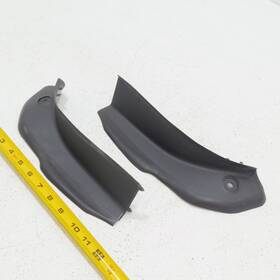
( Manufacturer Part Number: 51497410819 ), ( Country Of Origin: United States ), ( Type: Trunk ), ( Oe/oem Part Number: 51497410819, 51497410820, 7410820, 7410819, 204094, 7453333 ), ( Color: Black ), ( Features: No Drilling Required ), ( Finish: Matte ), ( Placement On Vehicle: Rear, Right, Left )
Review BMW 2pcs Rear Lh And Rh Trunk Lid Gutter Trim 7410819/20 fits F30 320I 328I 330I 2016–2018
The **BMW 51497410819 rear trunk lid gutter** is a precision-engineered component designed exclusively for the **F30 3 Series (2011 2018)** models, including the **320i, 328i, and 330i** variants, and is tailored for vehicles equipped with the **left-hand drive (LHD) or right-hand drive (RHD)** configuration. This high-quality gutter system, identified by the part number **7410819/20**, is crafted to seamlessly integrate with the rear trunk lid assembly, ensuring optimal water drainage and protection against road debris, rust, and corrosion. Engineered with BMW s signature attention to detail, this gutter features a durable, weather-resistant construction that maintains structural integrity even under harsh driving conditions. Its sleek, aerodynamic design complements the vehicle s contours, blending functionality with aesthetic appeal while preventing water buildup that could compromise the trunk lid s seals or compromise the integrity of the bodywork. The gutter s precise fitment ensures a tight seal, reducing the risk of leaks and maintaining the vehicle s resale value. Whether installed during a routine maintenance check or as part of a comprehensive restoration, this component is an essential upgrade for owners seeking to preserve their 3 Series performance and longevity, offering both practical benefits and a polished finish that aligns with BMW s reputation for excellence.
### **Pros and Cons of Buying a BMW F30 320i/328i/330i (2016 2018, LH/RH, Trunk Lid Gutter 7410819/20)**
#### **Overview**
The BMW F30 320i/328i/330i (2016 2018) is a well-regarded compact executive sedan known for its balance of performance, comfort, and driving dynamics. The **trunk lid gutter (7410819/20)** is a common part number for the rear hatch area, which may indicate minor cosmetic wear or a part that needs replacement. Below is a detailed breakdown of the key advantages and disadvantages of purchasing one of these models.
---
### **Pros**
1. **Strong Performance and Driving Dynamics**
- The **320i** (N55 engine) delivers **255 hp** and **320 lb-ft of torque**, offering a smooth and efficient driving experience with good acceleration.
- The **328i** (N55 with **300 hp**) provides a slight performance boost while maintaining fuel efficiency.
- The **330i** (N57 engine) produces **306 hp** and **300 lb-ft of torque**, offering more power for those who want a sportier feel without sacrificing practicality.
- All models feature **xDrive** (optional) for all-wheel drive, improving traction in adverse conditions.
- The F30 s **stiff chassis** and **precise steering** make it one of BMW s most engaging sedans.
2. **Comfort and Refinement**
- The cabin is **well-insulated**, reducing road noise, and features **high-quality materials** (especially in higher trims like **xDrive, M Sport, or Luxury**).
- **Comfortable seating** with good lateral support, making long drives enjoyable.
- **Adaptive suspension** (optional) improves ride comfort on rough roads.
3. **Technology and Infotainment**
- **iDrive 6** (2016 2018 models) offers a **larger touchscreen** (up to 10.25") with **Apple CarPlay and Android Auto** (in later models).
- **BMW ConnectedDrive** provides **remote start, navigation updates, and safety features** like **Collision Warning with City Braking**.
- **Available head-up display (HUD)** enhances visibility of key driving information.
- **Parking sensors and rearview camera** (standard on higher trims) assist with maneuvering.
4. **Reliability and Maintenance**
- The **N55 (320i/328i)** and **N57 (330i)** engines are **well-proven**, with fewer major issues compared to earlier BMW engines.
- **Turbocharged direct injection (TDI)** engines are robust if maintained properly (oil changes every **5,000 7,500 miles** are critical).
- **Transmission options** include:- **6-speed manual** (sporty, engaging)
- **6-speed automatic (ZF 6HP21)** smooth and reliable
- **8-speed automatic (ZF 8HP)** found in later 2018 models, more refined
- **Common issues** (if any) are usually **minor** (e.g., **clutch wear in manuals, minor electrical gremlins, or water pump failures** in higher-mileage examples).
5. **Resale Value and Brand Prestige**
- BMWs hold their value **better than most German brands**, especially well-maintained examples.
- The **F30 platform** is still respected, and these models are **easier to find parts for** compared to newer, more complex BMWs.
- Owning a BMW carries **prestige**, which can be appealing for some buyers.
6. **Practicality and Space**
- **Spacious cabin** with **good rear legroom** (better than many rivals like the Audi A4 or Mercedes C-Class).
- **Large trunk (15.7 cu. ft.)** and **folding rear seats** for extra cargo space.
- **Available panoramic sunroof** enhances the driving experience.
7. **Aftermarket and Customization**
- The F30 has a **strong aftermarket support**, with **tuning options (MHD, JE, BMS), suspension upgrades (BCM, Eibach), and aesthetic modifications**.
- **Performance chips** can unlock extra power (e.g., ** 350 hp in a 330i** with tuning).
- **Exhaust upgrades, cold air intakes, and wheel choices** are widely available.
---
### **Cons**
1. **Higher Maintenance Costs**
- BMWs are **notoriously expensive to maintain**, with **labor costs being one of the highest** in the industry.
- **Common maintenance items** include:- **Oil changes (every 5K 7.5K miles for TDI engines)**
- **Spark plugs (every 60K 100K miles)**
- **Timing belt (every 60K 100K miles, critical for N55/N57)**
- **Water pump replacement (often tied to timing belt)**
- **Brake pad and rotor replacements (every 30K 50K miles)**
- **Dealer vs. independent mechanic costs** can vary significantly, but **always use a trusted BMW specialist**.
2. **Electrical and Software Issues**
- **iDrive glitches** (freezing, unresponsiveness) are a **common complaint**, though later models (2017 2018) improved reliability.
- **Sensor failures** (e.g., **parking sensors, rain sensors, or blind-spot monitoring**) can be costly to repair.
- **Infotainment updates** may require a **dealer visit**, adding to expenses.
3. **Fuel Economy Trade-offs**
- While the **320i/328i** are **fuel-efficient (22 26 MPG combined)**, the **330i** drops to ** 20 MPG combined** due to its larger engine.
- **Diesel options (320d/330d)** are more efficient but have **higher upfront costs** and **more complex maintenance**.
4. **Comfort vs. Sportiness Trade-off**
- The F30 is **not as sporty as the F80 M240i or F82 M3**, lacking **active aerodynamics or launch control** (except in **M Sport packages**).
- **Ride is firm** while comfortable, it s **not as plush as a Mercedes C-Class or Audi A4**.
- **Manual transmission models** are **disappearing** (only available in **320i/328i** in some markets), making them harder to find.
5. **Common Wear-and-Tear Issues**
- **Rear hatch/gutter (7410819/20) problems** If the **trunk lid gutter is rusted or damaged**, it may require replacement ( $200 $500 parts labor). This is a **common issue in snowy climates**.
- **Rear suspension wear** **Struts and bushings** may need replacement after **80K miles**.
- **Clutch wear (manual models)** If not maintained, the **dual-mass flywheel (DMF) can fail**, costing **$1,500 **.
- **Exhaust leaks** **Turbocharged models** can develop **leaks at the turbo or exhaust manifold** ( $500 $1,200 to fix).
6. **Depreciation and Financing Challenges**
- While BMWs hold value **better than most**, they still **depreciate faster than luxury Japanese or American brands**.
- **Financing rates for BMWs are often higher** than for mainstream brands.
- **Insurance costs** tend to be **more expensive** than for similar-aged sedans.
7. **Limited Practicality for Large Families**
- **Rear seat comfort** is **not as spacious** as in a **Mercedes C-Class or Audi A6**.
- **Boot space is decent but not exceptional** compared to SUVs or hatchbacks.
---
### **Key Considerations Before Buying**
1. **Budget for Maintenance**
- **Expect to spend $1,500 $3,000/year** on maintenance if buying used.
- **Always check service records** a well-maintained F30 will last **200K miles** with proper care.
2. **Test Drive Essentials**
- **Listen for unusual noises** (turbo whine, exhaust leaks, suspension creaks).
- **Check for electrical gremlins** (test all buttons, screens, and sensors).
- **Test the transmission** (smooth shifts, no jerking in automatic models).
- **Inspect the undercarriage** for **rust (especially in snowy
Details:
BMW 328d F30 2016 -2018. Compatible model's. BMW 320I drive F30 2016 -2018. BMW 328d drive F30 2016 -2018.
See Video second picture. BMW 320I F30 2016 -2018. Usually ships the next day.
part #: 51497410819 prices
- $27.28-$95.56
specifications cartrimmouldings:
- for models: F30, 320i, 328i, 330i
- for makes: Bmw
- for years: 2016-2018
- mpn: 51497410819
- country of origin: United States
- type: Trunk
- oe/oem part number: 51497410819, 51497410820, 7410820, 7410819, 204094, 7453333
- color: Black
- features: No Drilling Required
- finish: Matte
- placement on vehicle: Rear, Right, Left
general cartrimmouldings:
- Car Truck Parts Accessories > Exterior Parts Accessories > Body Moldings Trims
- condition: Used
seller cartrimmouldings:
- city: Lincoln, Nebraska
- # reviews: 546
- rating: 100.0%
offer cartrimmouldings:
- options: Ship-to-home
- started: June 2, 2026
- sold: 0
- availability: In Stock
- quantity: 1
returns cartrimmouldings:
- paid by: Seller
- time: 30 Days
- policy: Returns Accepted
shipping cartrimmouldings:
- type: Calculated
- transit: 3-6 Days
- class: Standard
- carrier: UPS
- service: UPS Ground
- cost: $0.00
payments cartrimmouldings:
- credit card: Mastercard
- other
- wallet: Google-pay
Bmw 51497410819 Is Similar To:
- Bmw Oem 51377248146 11-16 X3-molding Trim Right (34.3% similar) ...(October 21st, 2023)
- Bmw 51177294372 X5 F15 Rear Right Side Quarter Wheel Arch Flare Molding Oem 2014 2018 (37.8% similar) Donor vehicle: 2015 bmw x5 F15 35I drive 3 .0L automatic transmission. Mileage: 129K miles. Products sold in quantities will show a single image representing the others equal or greater condition. Color: white 300-ALPINE white exterior / black Lucas interior...(November 10th, 2023)
- Bmw 64319353042 12-18 F30 3 4 Series Front Right Windshield Cowl Cover Molding Trim Oem (31.1% similar) Item comes as seen in the pictures. Donor vehicle: this came off of a 2017 bmw 440XI gran coupe. Vehicle had 84K miles. Int color code: sensed vent beige. 17 F36 440XI G189431. Ext color code: imperial blue brilliant metallic...(December 7th, 2023)
- Bmw 51357263379 2012-2016 328i F30 Rear Driver Side Door B Pillar Molding Trim Black Oem (40.9% similar) Part #: bmw 51357263379 for sale...(January 10th, 2024)
- Bmw 6162 7118206 2006-2012 325xi 335i Right Passenger Rh Rear Door Sill Sedan (31.8% similar) All electronics are tested before removed from vehicle. All the parts are tested either before or after removal from vehicle. Item may show light scuffs, scratches or other imperfections as a result of this being used part. Shipping prices for ground apply only to the continental USA...(January 25th, 2024)
- Bmw 7216977 2011-2016 F10 F12 Front Left Windshield Cowl Vent Trim Panel Cover Oem (35.4% similar) Instagram: oem.auto parts oem front left windshield cowl vent trim panel cover off from 2014 bmw F10 550XI. Some electronics items may need to be reprogrammed function, an electronic item not function without the proper programming. All of the parts were taken off donor cars with great care...(January 28th, 2024)
- Bmw 51131917997 1982-1988 E28 5-series Rear Side Air Vent Cover Sail Trim Pair Black Oem (40.9% similar) See the photo below for illustration. 1982 - 1988 bmw E28 5-SERIES rear side air vent cover sail trim pair black oem: stock #: 44071. The right side panel has a bend along its edge. Still not sure this part will fit your car. Which side does this part fit?, left driver side, right passenger. These...(April 19th, 2024)
- Bmw Bmw635csi E24 635csi 633csi Right Rear Exterior Window Chrome Trim Lm06 (36.9% similar) Condition is used. Bmw E24 635CSI 633CSI right rear exterior window chrome trim LM06. Shipped with USPS ground advantage...(April 20th, 2024)
- Bmw 51.12 7065 478 2003 2004 2005 2006 E46 325ci Convertible Rear Bumper Tow Hook Cap Cover Oem (31.7% similar) 2003 2004 2005 2006 bmw E46 325CI convertible rear bumper tow hook cap cover oem MANO4-034 41224. The item on the pictures is exact you are buying...(April 28th, 2024)
- Bmw 64318370066 Oem E46 99-06 Microfilter Lid Cabin Filter Trim Cover Seal (35.9% similar) Part fitment will vary due to several different factors: the vehicles build date month year. Electric/manual, leather/vinyl, sport/standard etc. Manual or automatic transmission engine size. Multiple quantity items may vary slightly depending on stock hand, but will always be the same quality or ...(May 3rd, 2024)
- Bmw 6958250 05 06 07 08 09 10 11 12 13 335i E92 Coupe Rear Right Passenger Door Trim Oem (35.4% similar) This used item comes with a 30 day warranty parts only - no labor...(May 5th, 2024)
